Cabinet Door Samples for Trade Pros
A trade buyer who arrives at a client meeting with one door in a bag is asking the client to imagine the kitchen; one who arrives with eight is letting the client hold it. CasaBuilt sells each sample door for $9.99, refundable with a cabinet purchase, and applies 15-25% preferred pricing to the order that follows. On a $16,000 cabinetry budget that band is worth $2,400 at the low end and $4,000 at the high end.
Key takeaways
- The published sample range is 16 doors: 8 Shaker, 3 Double Shaker, 3 Slim Shaker and 2 Frameless.
- A standard sample door is $9.99, listed against $19.99, and refundable with a cabinet purchase.
- Trade pricing runs 15-25% below standard retail with no strict annual minimum.
- On a $16,000 budget the band is $2,400 at 15% and $4,000 at 25%, a spread of $1,600.
Why a door in the room beats a rendering
Clients approve finishes in the wrong conditions. A door photographed under studio light reads cooler or warmer than the same door in a north-facing kitchen, and a screen cannot show the depth of a Shaker rail or the sheen across a painted panel. The sample is not a marketing extra. It is the only piece of the specification a client can weigh in a hand before money changes hands.
The stakes are different for a trade buyer. A homeowner chooses once and lives with the result. A trade buyer may pitch the same three profiles to five clients in a month, and a finish rejected after a deposit is a scheduling problem before it is an aesthetic one. A working set of doors in the van turns that conversation into a few minutes at a kitchen table instead of a second showroom visit that does not exist.
CasaBuilt sells direct, so there is no display kitchen to send a client to. What replaces it is a sample page, a free 3D kitchen design delivered in 24-48 hours, and a trade route with room designs in less than 72 hours. The trade programme publishes 15-25% preferred pricing against standard retail, quoting assistance and priority support, with no strict annual minimum to qualify.
What the 16 doors actually cover
The published range is 16 doors: eight Shaker, three Double Shaker, three Slim Shaker and two Frameless. Those four groups are not colourways of one door. They are four different edge geometries, and the difference shows up at arm's length, which is exactly the distance a client sits from a cabinet.
The Shaker door is the five-piece construction most buyers already recognise: a flat centre panel held by four rails and stiles. Double Shaker adds a second inner line, so the panel reads as a framed picture inside a frame. Slim Shaker narrows the outer frame and lets the panel take more of the face. Frameless pairs a full-overlay door with a box that has no face frame at all, which changes how the gaps between doors line up across a run.
Colour is a separate filter on the same page: five white doors, three gray, two brown, one black, one beige, one green and one navy. Two doors sit outside the standard set and are priced separately, Black Quarterline at $19.50 and Beach Impression at $22.00. For a trade buyer the practical point is that the range is small enough to own in full. Sixteen doors at $9.99 is $159.84, less than the freight on most single-cabinet replacements.
The trade band in real numbers
The published band is a range, not a rate, and the gap between the two ends is wide enough to change what a client can afford inside the same layout. The company's own example works from a $12,000 to $18,000 cabinetry budget and quotes $1,800 to $4,500 of direct savings. The table applies both ends of the band across the middle of that range so a trade buyer can see the slope rather than a single headline figure.
| Cabinetry budget | Saved at 15% | Saved at 25% | Net at 15% | Net at 25% |
|---|---|---|---|---|
| $12,000 | $1,800 | $3,000 | $10,200 | $9,000 |
| $14,000 | $2,100 | $3,500 | $11,900 | $10,500 |
| $16,000 | $2,400 | $4,000 | $13,600 | $12,000 |
| $18,000 | $2,700 | $4,500 | $15,300 | $13,500 |
Two readings matter. First, every $1,000 added to the budget is worth $150 at the low end of the band and $250 at the high end, so the value of the discount scales with the job rather than being a fixed coupon. Second, the 25% column at $18,000 lands exactly on the $4,500 the company publishes as the top of its example, which is a useful cross-check when a quote arrives with a number that does not fit either end.
Running the presentation in a client's kitchen
Three doors per meeting is the workable number, and they should go on the table one at a time. A client confronted with a fan of samples compares colours; a client handed a single door compares it to the floor, the worktop and the light from the window. Take the door back, hand over the second, and ask which one they would still like in five years. The answer is usually immediate.
Leave the chosen door behind for a week if the client wants to live with it. This is where the refundable fee earns its place: every cabinets door sample in the range costs $9.99 and is refundable with a cabinet purchase, so three doors left across three clients ties up $29.97 rather than a sale. That is cheaper than re-cutting a door and far cheaper than a cancelled install.
Log the decision while it is fresh. Note the profile, the colour family and the room the client saw it in, because the same door reads differently against a dark floor. The trade programme pairs that record-keeping with quoting support and a quick-ship commitment of three business days or less for eligible orders, which is the point where a finish decision turns into a delivery date.
Worked example: what the band is worth on three budgets
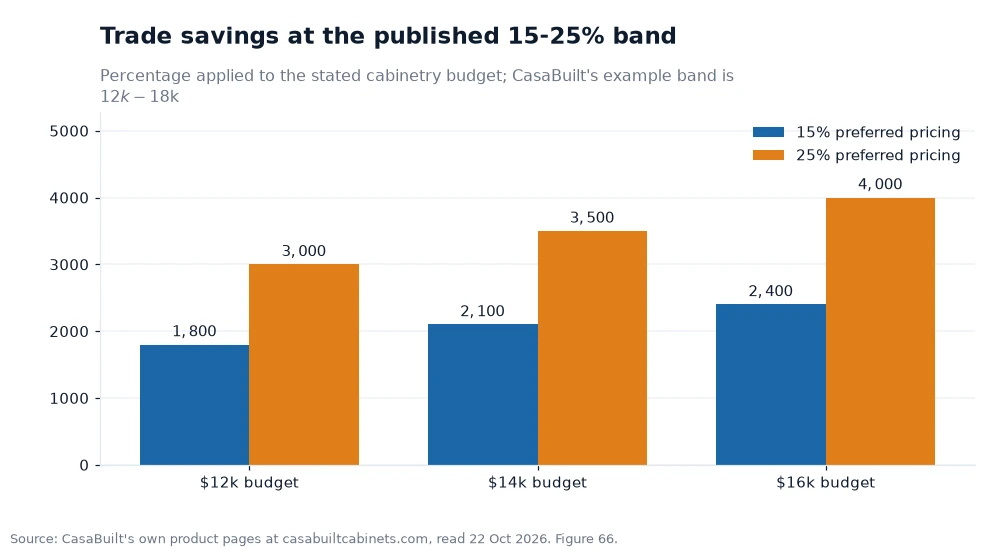
The chart quotes $1,800, $2,100 and $2,400 at 15% for budgets of $12,000, $14,000 and $16,000, and $3,000, $3,500 and $4,000 at 25% for the same three budgets. Check the arithmetic: $12,000 x 0.15 = $1,800 and $12,000 x 0.25 = $3,000. Then $14,000 x 0.15 = $2,100 and $14,000 x 0.25 = $3,500. Then $16,000 x 0.15 = $2,400 and $16,000 x 0.25 = $4,000.
The spread between the two ends widens with the job: $1,200 at $12,000, $1,400 at $14,000 and $1,600 at $16,000. Set the $1,600 against the cost of the sample set and the ratio is lopsided. $1,600 divided by $9.99 is 160.16, so the difference between the two ends of the band on a $16,000 job buys 160 sample doors with $1.60 left over. Even the $1,200 spread at the bottom of the range is 120 doors and $1.20 in change. A trade buyer who keeps eight doors in the van has spent $79.92 against a decision worth four figures.
Frequently asked questions
How many sample doors should a trade buyer keep on hand?
Four covers most presentations: one Shaker, one Slim Shaker, one Double Shaker and one Frameless, chosen in the colour families the client base asks for. The full published range is 16 doors, and at $9.99 each a four-door working set costs $39.96, refundable with a cabinet purchase. Keep the two premium doors, Black Quarterline at $19.50 and Beach Impression at $22.00, for clients who ask for something outside the standard palette.
Does the sample fee come off a trade order?
The published terms list the sample at $9.99 against a $19.99 list price, refundable with a cabinet purchase, and the trade programme applies 15-25% preferred pricing to that order. The refund is tied to a cabinet purchase rather than to the trade account itself, so a sample bought during a pitch comes back when the client orders. Nothing in the published terms sets a minimum sample spend.
Can a sample be used in a pitch before any order exists?
Yes. The door is bought outright at $9.99 and becomes a refund only when cabinets are purchased, so it can travel to as many client meetings as the buyer likes without a commitment from anyone. That also makes it a reasonable item to leave with a client who is deciding between two profiles, because the cost of the loan is the cost of the door.
Build the sample set before the next pitch
Order the four profiles that match the work you actually sell, add one door from each colour family your clients keep asking about, and keep the set in a case rather than a bag so the edges stay clean. Note the price of each door against the order it belongs to, because the refund only lands if the cabinet purchase happens.
Then run the next meeting with three doors and no catalogue. The client who holds the door is deciding on a finish; the client who reads a spec sheet is still deciding whether to start. The first conversation closes faster, and the $9.99 on the table is the cheapest part of the job.
Figures quoted here come from the manufacturer's own website, read 22 Oct 2026[1].