What a Perfume Quote Actually Covers: A Cost Breakdown for New Brands
A perfume quote is not a price; it is a bundle of six or seven separate decisions expressed as one number. Two suppliers can quote the same figure and deliver very different products, and one supplier can quote 30 percent less while costing more overall. Reading the quote line by line is the only way to compare, and the cost lines that matter most are the ones most often left out of the document.
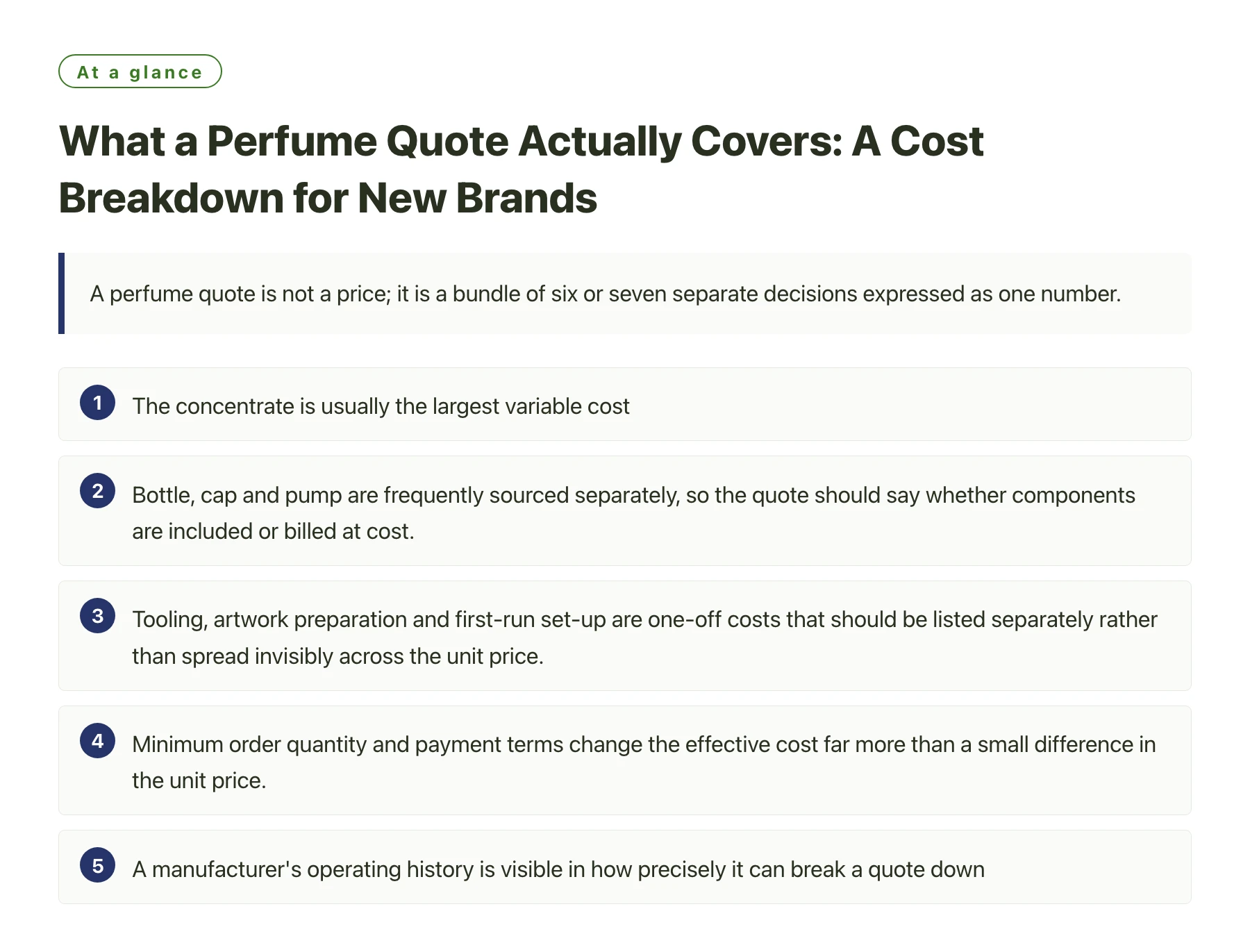
Key takeaways
- The concentrate is usually the largest variable cost, and it is driven by dosage and material choice rather than by the number of notes on the label.
- Bottle, cap and pump are frequently sourced separately, so the quote should say whether components are included or billed at cost.
- Tooling, artwork preparation and first-run set-up are one-off costs that should be listed separately rather than spread invisibly across the unit price.
- Minimum order quantity and payment terms change the effective cost far more than a small difference in the unit price.
- A manufacturer's operating history is visible in how precisely it can break a quote down, which makes the document itself a due-diligence signal.
Buyers comparing three quotations usually put them in a spreadsheet, align the unit price column and pick the lowest. That comparison is almost always wrong, because the three documents are rarely quoting the same scope.
The method below is the one a purchasing manager would use: separate the quote into fixed and variable lines, identify which lines move with volume, and price the one-off items on their own.
The seven lines in almost every quote
Whether or not the supplier writes them out, a fragrance manufacturing quote contains the same categories of cost: concentrate, primary packaging, secondary packaging, filling and assembly, testing and documentation, tooling and set-up, and freight. The difference between a usable quote and a decorative one is whether all seven appear as separate lines. A factory that keeps all of that work fragrance manufacturing under one roof can usually split the lines itself, because the internal cost centres already exist.
Ask for the split even when the answer comes back as a single unit price. A supplier that can produce the split is one that knows its own process; a supplier that cannot usually cannot explain a variance later either.
Which lines move, and what moves them
| Cost line | Fixed or variable | Main driver |
|---|---|---|
| Concentrate | Variable | Dosage percentage, material palette, order volume |
| Bottle | Mostly step-fixed | Mould availability, decoration method, quantity breaks |
| Cap and pump | Mostly step-fixed | Whether a standard closure is used or a new one is tooled |
| Carton and label | Step-fixed | Print method, finish, whether the artwork needs a new die |
| Filling and assembly | Variable with labour content | Degree of hand work in decoration and packing |
| Testing and documentation | Fixed per project | Which markets the product is registered for |
| Tooling and set-up | One-off | New components, new artwork, machine changeover |
The concentrate line is the one buyers negotiate hardest and understand least. It is set by dosage and materials, so a cheaper quote at the same dosage is usually a different material palette rather than a better deal.
Where a low unit price hides its money
A quote that undercuts the others by a wide margin is not automatically dishonest, but it is worth asking four questions before treating it as a saving. Which components are excluded? What minimum order quantity applies? Which testing and documentation costs are billed separately? And what does the payment schedule look like?
Tooling is the most common omission. A bespoke bottle mould or a custom cap can cost more than the entire first order of juice, and it is a real cost whether it appears on the quote or arrives as a later invoice. If the supplier owns the mould and you do not, the second question is what happens to that tooling at the end of the relationship. Industrial designs can be registered through national systems or through the international route administered by WIPO, and a registration is only useful if the brand, not the supplier, holds it [3]. For a line-by-line example of how these costs are usually presented, reading a perfume price breakdown is worth reading alongside the quote in front of you.
Minimum order quantity is a cost, not a condition
A low unit price at a high minimum can tie up more cash than a higher unit price at a lower minimum. Compare total cash outlay for the first order, not unit price alone. For a launch in a new market, the ability to order small and reorder quickly is usually worth more than a discount on volume you have not yet sold.
It is also worth asking what the reorder minimum is. Some suppliers set an attractive first-order minimum and a much larger reorder minimum, which turns a market test into a commitment.
Payment terms change the real cost
A deposit of 30 percent with the balance against documents is a different proposition from 50 percent up front with the balance before shipment. Neither is unfair, but the working capital difference over a two-month lead time is measurable, particularly for a first order that is not yet generating revenue.
Documentation is a deliverable, not overhead
Testing and compliance paperwork varies by destination market, and a supplier that exports regularly already carries the fixed cost of keeping templates and test partners in place. That experience usually shows up in the quote as a modest, clearly stated line rather than as an unquantified "compliance" surcharge added later. It is also the line that determines whether the batch arrives with usable records: a cosmetics GMP framework such as ISO 22716 exists to make testing and traceability routine rather than exceptional [1].
Reading the supplier behind the number
The quote format is itself evidence. A supplier with a long manufacturing history tends to quote with a standard structure, because the structure comes from its own cost accounting rather than from improvisation. That is one reason it is worth looking at a manufacturer's operating background and certification position before the commercial conversation starts: it tells you what kind of document to expect. A partner such as Xuelei's 31 years in fragrance publishes its service scope and certification list, which means the quote can be checked against a written description of the work rather than against a sales conversation.
Practical signals to look for: a stated dosage range, a named component specification rather than "glass bottle", a separated tooling line, an explicit reorder minimum, and a written list of what the price does not include. If any of those is missing, ask for it in writing before comparing the numbers.
Compare on landed cost, not on unit price
Freight, insurance and duty belong in the comparison even though they are not the manufacturer's lines. A cheaper unit price from a distant factory can lose to a nearer one once a full container of finished consumer units is priced door to door. For a first order in a new region, ask both suppliers to quote the same Incoterm so the comparison is meaningful. Note also that compliance obligations attach to the finished product rather than to the components, and the requirements are published by the regulators that enforce them [2]; whoever assembles the file should be identified before the freight is booked.
Write the assumptions into the purchase order
Every quote rests on assumptions: dosage, fill volume, component grade, packing configuration, tolerance. Repeating them in the purchase order costs nothing and prevents the specific argument that wastes the most time — the one where both sides are correct about a number they understood differently.
A useful habit: convert every quote to a total cost for the first order at the supplier's stated minimum, including tooling, testing and freight. That single number is the only one that can be compared across suppliers, and it is rarely the number on the first page of any of them.
Sources
- SGS: Cosmetics, Personal Care & Household Testing —— Testing, inspection and certification services for cosmetics and personal care, including microbiological, stability and safety testing aligned with cosmetics GMP.
- European Commission: Cosmetics in the EU —— The European Commission's overview of EU cosmetics rules, including the responsible person, product information file and safety report requirements.
- WIPO — World Intellectual Property Organization —— The UN agency for intellectual property; resources on industrial design and patent protection relevant to product and packaging design.
Frequently asked questions
What is the biggest cost in a bottle of perfume?
For most projects the concentrate is the largest variable cost, because it scales with dosage and with the material palette. Packaging can overtake it on a premium bottle or a decorated carton, which is why the split matters more than the total.
Why do two suppliers quote very different prices for the same brief?
Usually because they are not quoting the same thing. Differences in dosage, component grade, decoration method, minimum quantity, testing scope and payment terms explain most of the gap. Ask each supplier to state those assumptions explicitly before comparing.
Should I pay for tooling separately or have it included in the unit price?
Either can work. What matters is that the arrangement is written down, including who owns the tooling and what happens to it if you move to another manufacturer. Tooling spread across the unit price is convenient but can obscure the total commitment.
How do payment terms affect the price I should accept?
A larger up-front payment ties up working capital and shifts risk to the buyer, so a lower unit price may not compensate. Compare the cash profile of each offer over the production period rather than the headline figure alone.
Is a higher dosage always better?
Not always. Higher dosage generally improves longevity and presence, but it also raises cost and can unbalance a composition that was designed for a lower level. The right answer is the lowest dosage that meets the performance the brief specified.